

Did you know the Victorian land tax threshold recently plummeted from $300,000 to just $50,000? This shift has brought thousands of Geelong and Bellarine property owners into the tax net for the first time. Using a land tax calculator victoria is now a vital step for anyone wanting to avoid unexpected bills. It's understandable if your latest assessment feels like a shock, especially when the figure on the paper doesn't seem to align with what you believe your home is worth. Clarity. It is the first step toward financial predictability and reducing the stress of property ownership.
We agree that the distinction between market value and site value is often confusing. However, mastering these details is the only way to ensure you aren't overpaying. This guide promises to help you master the 2026 landscape and identify every exemption you're entitled to. We will explore the latest rules, including partial Principal Place of Residence (PPR) exemptions for income-earning homes and the 4% absentee owner surcharge. You will also learn how to manage land tax during a property transfer and why sellers can no longer pass these costs to buyers on contracts under A$10.7 million. Let's make your tax obligations straightforward and manageable.
• Precision. Use a land tax calculator victoria to navigate the 2026 thresholds and understand how the State Revenue Office uses site value to determine your annual liability.
• Protection. Identify whether your property triggers the 4% absentee owner surcharge or the newly expanded Vacant Residential Land Tax to ensure you meet essential February deadlines.
• Clarity. Confirm your Principal Place of Residence exemption and discover how the 2026 rules allow for partial exemptions on homes that also generate income.
• Strategy. Learn how land tax adjustments work during a property transfer and why sellers are now prohibited from passing these costs to buyers in contracts below A$10.7 million.
Land tax is an annual tax levied by the State Revenue Office (SRO) on the land you own in Victoria as of midnight on 31 December each year. It is a form of land value tax in Australia that helps fund essential state services like health and education. While it's a standard part of property ownership, it remains distinct from other costs. Council rates are paid to your local municipality, such as the City of Greater Geelong, to fund local infrastructure. Stamp duty is a one-off payment made during a property transfer. Land tax, however, is a recurring state-based obligation that requires annual planning.
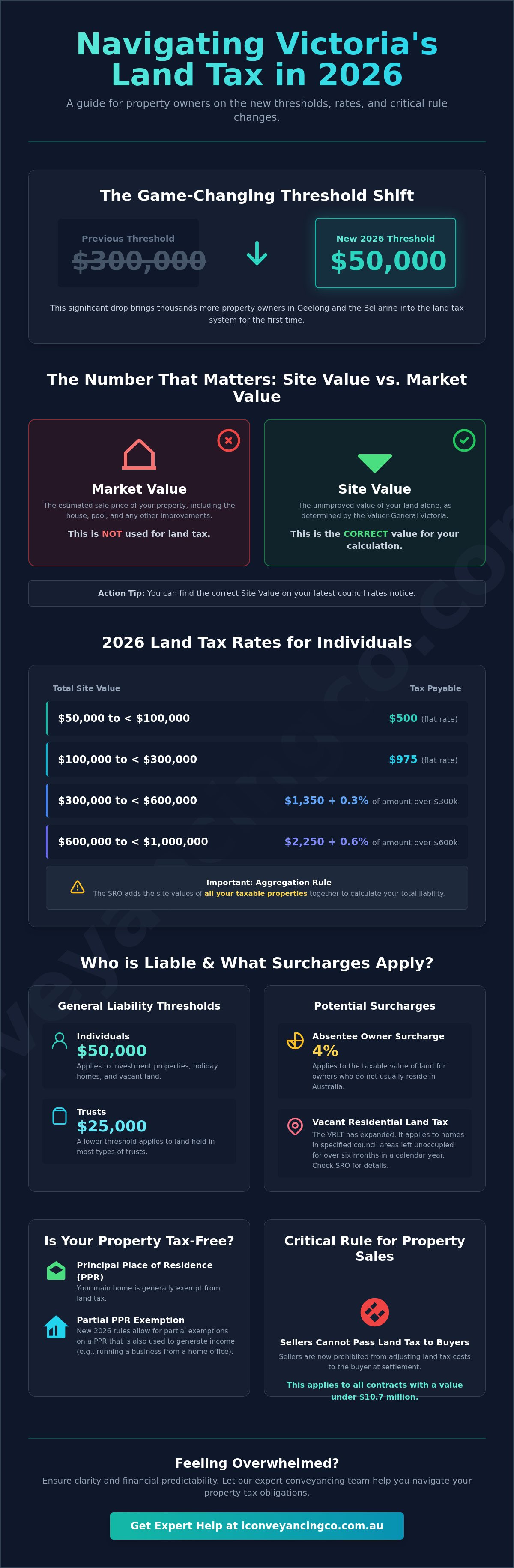
The 2026 thresholds reflect significant changes that began in 2024. For individual owners, the tax-free threshold sits at just A$50,000. This lower entry point means many more property owners in the Geelong and Bellarine regions now receive an annual bill. If you own multiple properties, the SRO adds their taxable values together to determine your total liability. Understanding these figures is vital. Using a land tax calculator victoria helps you stay ahead of these costs and ensures your investment remains profitable.
Liability depends on the type of property you own and how you hold it. Most investment houses, commercial buildings, and vacant land parcels trigger a tax bill once they exceed the threshold. For individuals, the threshold starts at A$50,000, while land held in trusts faces a lower threshold of A$25,000. Holiday homes in coastal towns like Portarlington or St Leonards are a common source of confusion. If the property isn't your primary residence, it's generally taxable. Even if it's a cherished family getaway used only during summer, the SRO considers it a secondary holding.
Accuracy is the foundation of a reliable tax estimate. Your land tax isn't based on the market value, which is what a real estate agent might suggest your property would sell for. Instead, it relies on the "Site Value." This figure represents the unimproved value of the land, excluding the house, pool, or any other buildings. The Valuer-General Victoria determines these figures annually through a mass valuation process. When you use a land tax calculator victoria, you must input the Site Value found on your latest council rates notice. This distinction is crucial because the Site Value is often significantly lower than the market value, making it the only figure that matters for your calculation.
Land tax in Victoria operates on a sliding scale. This means as the total value of your land increases, the rate of tax you pay also climbs. A critical concept to understand is aggregation. The SRO doesn't look at your properties in isolation. Instead, they bundle the site values of every taxable property you own into one total. If you own a small unit in Geelong and a vacant block in St Leonards, their combined value might push you into a higher tax bracket. This is why a land tax calculator victoria is such a helpful tool for investors; it helps you see the "big picture" of your tax liability.
The 2026 rates include the COVID-19 debt repayment surcharge, which is a temporary measure scheduled to remain in place until 2033. For properties with a total taxable value above A$300,000, the current land tax rates factor in a surcharge of A$975 plus 0.1% of the total land value. Additionally, if you are an absentee owner, meaning you don't usually reside in Australia, a 4% surcharge applies to the taxable value of your land. These layers of taxation make accuracy essential during a transfer of ownership to ensure no surprises arise at settlement.
Most individual owners fall under the general land tax rates. Here is a simplified look at the 2026 brackets for individuals:
• A$50,000 to < A$100,000: A$500 flat fee.
• A$100,000 to < A$300,000: A$975 flat fee.
• A$300,000 to < A$600,000: A$1,350 plus 0.3% of the amount over A$300,000.
• A$600,000 to < A$1,000,000: A$2,250 plus 0.6% of the amount over A$600,000.
Consider a hypothetical investment property in St Leonards with a site value of A$450,000. To calculate the tax, you take the base amount of A$1,350 and add 0.3% of the A$150,000 that exceeds the A$300,000 threshold. This results in a total annual land tax bill of A$1,800. Using a land tax calculator victoria ensures you can run these scenarios for your specific portfolio with confidence.
Land held in a trust is subject to different rules and generally higher rates. The tax-free threshold for most trusts is lower, starting at just A$25,000 compared to the A$50,000 individual threshold. For example, land in a trust valued between A$250,000 and A$600,000 incurs a base tax of A$1,901 plus 0.675% of the value over A$250,000. It's vital to notify the SRO of any beneficial interests in the trust. Failing to do so can lead to unexpected surcharges or penalties. Transparency with the SRO is the best way to maintain financial predictability.
Surcharges. These additional costs can transform a predictable investment expense into a significant financial burden. While a standard land tax calculator victoria provides a base estimate, it often misses specific surcharges that apply to foreign owners or empty properties. Accuracy in your declaration is the only way to protect yourself from the State Revenue Office's (SRO) strict compliance program. Failing to disclose your status by the 15 January deadline can lead to substantial back-taxes and interest penalties.
The absentee owner surcharge applies to individuals who are not Australian citizens or permanent residents. It also targets foreign corporations and trusts. As of 2024, this rate doubled to 4% of the taxable value of your land. This is paid in addition to the general land tax rates we discussed earlier. If you hold property in a foreign trust, the SRO requires clear notification to avoid errors. Some owners may qualify for an exemption if they can demonstrate their activities provide a significant economic contribution to Victoria, but these cases are assessed on a strict individual basis.
The Vacant Residential Land Tax (VRLT) is separate from general land tax. It targets homes in metropolitan Melbourne and specific regional areas that remain unoccupied for more than six months in a calendar year. From 1 January 2026, this tax expanded. It now includes land in metropolitan Melbourne that has been undeveloped for five or more continuous years. The SRO monitors occupancy through various data points, including utility usage and government records. If your property is identified as vacant, you must notify the SRO by 15 February 2026.
Fortunately, several land tax exemptions exist to support genuine property use. For many in the Geelong and Bellarine regions, the holiday home exemption is the most relevant. To qualify, you or your family must use the property as a holiday home for at least four weeks during the calendar year. Keeping your contact details updated with the SRO ensures you receive these notifications and can claim relevant benefits on time. Using a land tax calculator victoria with these surcharges in mind helps you maintain a clear and proactive view of your property costs.
Efficiency. It's the hallmark of a well-managed property portfolio. While the land tax calculator victoria helps you estimate your liability, the real value lies in identifying legal ways to reduce that figure. Most owners are aware of the Principal Place of Residence (PPOR) exemption, but the 2026 rules have introduced nuances that could save you thousands. Beyond your family home, several other categories can exempt your land from tax entirely, provided you meet strict criteria set by the State Revenue Office (SRO).
Primary Production Land (PPL) is a significant exemption for many in the rural pockets of Geelong and the Bellarine Peninsula. If your land is used primarily for business-scale farming, such as grazing, cropping, or viticulture, it may be exempt. Additionally, land used by charities, non-profit health centres, and certain sporting clubs often qualifies for tax-free status. To verify your position, use this checklist:
• Is the property your sole principal place of residence?
• Is the land used for primary production with a genuine profit motive?
• Does the land hold a specific exemption for charitable or community use?
• Have you recently inherited a property that qualifies for the deceased estate transition?
The PPOR exemption is generally limited to one home per couple or family. If you own a home in Geelong and a beach house in Ocean Grove, only the one you physically reside in as your primary home is exempt. However, 2026 brought a helpful change. You can now claim a partial PPOR exemption if a portion of your home is used for income generation, such as a dedicated short-stay wing. If you are moving house, you may be able to claim an exemption on both properties for a limited time. Furthermore, the "unfit-to-live" exemption for homes under renovation has been extended to four years as of 2026. If you are planning a transfer of ownership as part of a move, ensure your timelines align with these SRO windows.
Accuracy. If you receive an assessment that seems based on an inflated Site Value, you have the right to object. You must lodge your objection within 60 days of receiving your notice. This is a strict deadline. Most objections focus on two areas: the valuation is too high compared to similar land, or the ownership data is incorrect. The SRO provides an online portal for this process. Before lodging, use a land tax calculator victoria to model what the tax should be based on a more realistic Site Value. Having clear evidence, such as a recent independent valuation or proof of property condition, will strengthen your case significantly.
Settlement. It is the final step in your property journey. While you have used a land tax calculator victoria to plan your annual budget, the settlement process introduces a different set of calculations. Land tax must be accounted for to ensure the title transfers clearly and neither party is left with an unexpected debt. In Victoria, this is managed through the Section 32 Vendor Statement. This document must disclose any land tax liabilities affecting the property, ensuring transparency from the moment the contract is signed.
Accuracy is vital at this stage. A mistake in disclosure or a failure to account for a recent assessment can lead to delays or financial disputes. At i.Conveyancing.Co, we act as your proactive partner, ensuring every tax obligation is identified and addressed well before the keys change hands. Whether you are buying properties or selling, we focus on making the numbers work for you.
Traditionally, land tax was adjusted between the buyer and seller at settlement. The seller would pay the full year's bill, and the buyer would reimburse a proportional share for the days they owned the property. However, 2026 has brought a major shift. For contracts of sale below A$10.7 million, sellers are now prohibited from passing on land tax costs to buyers. This change significantly reduces the "adjustment" costs for many buyers but requires sellers to be more strategic with their budgeting. If you are selling an investment property, you can no longer assume the buyer will cover a portion of your 2026 tax bill.
Protection. This is what a Land Tax Clearance Certificate provides. It is an official document from the SRO confirming that all land tax for a specific property has been paid. If a seller has unpaid land tax, the SRO can place a charge on the land. This means the debt follows the property, not the person. If you buy a property without a "clear" certificate, you could become liable for the previous owner's tax bill. This is a risk no buyer should take.
Fiona Barber and the team at i.Conveyancing.Co prioritise your peace of mind by ensuring a clearance certificate is obtained for every settlement. We handle the administrative burden of checking for "chargeable" land tax and coordinating with the SRO. This proactive approach prevents delays and protects your investment from day one. Whether you are dealing with vacant land conveyancing or a complex deceased estate transfer, we ensure the numbers are accurate. Using a land tax calculator victoria is a great way to plan, but having a qualified expert manage your settlement is how you secure your property's future.
Predictability. It is the ultimate goal for any property owner navigating the 2026 tax landscape. By now, you understand how the lowered thresholds and complex aggregation rules can impact your bottom line. Using a land tax calculator victoria is a powerful first step, but the real protection comes from expert oversight. Whether you are identifying a partial PPOR exemption or ensuring a clean title during a transfer, accuracy is your best defence against the State Revenue Office. Clarity helps turn an administrative burden into a manageable part of your investment strategy.
Confidence. Fiona Barber and the team at i.Conveyancing.Co bring over 20 years of Victorian property experience to your settlement. We specialise in Geelong and Bellarine Peninsula transactions, offering the transparent and direct communication you need to lower your stress levels. We ensure every adjustment is precise and every clearance certificate is verified, protecting you from inheriting someone else's debt.
Get a Fixed-Fee Conveyancing Quote for Your Victorian Property
Ready to move forward? We are here to act as your proactive partner, turning complex legal processes into a straightforward path to success. Your peace of mind is our priority.
No. Your main home is usually exempt under the Principal Place of Residence (PPR) rule. However, from 2026, you might face a partial tax if you use a specific portion of your home for income, such as a dedicated short-stay rental wing. It's a sensible idea to check your status if your home's usage has changed recently.
Joint ownership involves a two-step assessment. First, the State Revenue Office (SRO) assesses the property as if it's owned by one person. Then, each owner is assessed individually on their proportional share of all land they own in Victoria. This ensures the correct tax bracket is applied based on your total property holdings across the state.
Site value is the value of the land alone. It excludes buildings, landscaping, or any other improvements you've made to the property. The price you paid is the market value, which includes the house and land together. When using a land tax calculator victoria, always use the site value found on your latest council rates notice for accuracy.
Yes. You have a 60 day window from receiving your assessment to lodge an objection with the SRO. You'll need to provide clear evidence, such as a recent independent valuation or proof of property issues, to show why the Valuer-General's figure is incorrect. This process is highly structured and requires strict adherence to the deadline.
Generally, yes. If your property is used to generate rental income, land tax is a deductible expense for Australian income tax purposes. This helps offset the cost of holding the investment. It's always best to confirm the specifics with your tax professional to ensure you're claiming all eligible deductions correctly.
Settlement changes how tax is handled. For contracts under A$10.7 million signed in 2026, sellers are prohibited from passing land tax costs onto the buyer. We ensure all outstanding tax is cleared via a Land Tax Clearance Certificate before the transfer. This protects the buyer from inheriting any of the seller's unpaid tax debts.
Foreign investors face a significant additional cost. The absentee owner surcharge is 4% of the taxable land value, which is added on top of the general land tax rates. This status must be declared to the SRO by 15 January each year. Failing to disclose this can lead to heavy penalties and back-dated tax bills.
Yes. Commercial land in regional areas like Geelong is subject to land tax once the site value exceeds the threshold. While some primary production land remains exempt, standard commercial offices, warehouses, and retail shops are generally taxable. Using a land tax calculator victoria helps commercial owners budget for these annual state-based costs effectively.